

Financial capability is critical to helping Australians navigate an increasingly complex financial system, make informed decisions and build long-term financial wellbeing. Yet access to financial education remains inconsistent across Australia’s education system.
Every young Australian should leave school knowing how to budget, save, avoid scams, understand superannuation and make informed financial decisions.
While consumer and financial literacy is addressed in the Australian Curriculum, implementation varies between States, schools and classrooms, leaving access dependent on where a student lives and who teaches them.
New research found 94% of young people believe financial literacy should be taught in schools, while only 46% of school leavers recall learning about money and finance during their education.[1]
Unpacking the financial confidence and capability of young Australians
New research by Financial Basics Foundation (FBF) and Australian Retirement Trust (ART) completed in August 2026 found that young Australians are highly motivated to improve their financial capability but face growing financial pressures, declining confidence, and gaps in access to financial education.
Young Australians are worried about their financial futures
Young Australians are entering adulthood during a period of considerable economic uncertainty. Common challenges include saving money, managing everyday expenses, dealing with unstable income and covering unexpected costs.
- 62% of young Australians are dissatisfied with their finances
- 82% experience money-related stress
- 48% report feeling overwhelmed by their financial future
At the same time, the information environment is changing rapidly. 15% of young Australians report using AI tools such as ChatGPT for financial advice, rising to 22% among those aged 22-24.
The gender gap starts early
Financial pressures weigh more heavily on young women, with 85% experiencing financial stressors, like bills, unexpected expenses and saving, compared to 78% of men. Young women are struggling to answer basic financial literacy questions and feel less satisfied with their situation.
- Only 17% of young women answered the three benchmark financial literacy questions correctly, compared with 26% of young men.
- 32% of young women are satisfied with their financial situation, compared to 44% young men.
- 34% of young women aged 22-24 say they manage their finances well, compared to 60% of young men.
Financial education can make a difference
The evidence suggests effective financial education develops more than knowledge. It builds the confidence, judgement and behaviours young people need to make informed financial decisions throughout life.
Young Australians who recall learning about money at school are more likely to
- feel confident making financial decisions (47% compared with 40%)
- report managing their money well (55% compared with 41%).
Feedback from users of FBF resources confirms this positive impact. Among 16-17 year olds, participants were more confident in their ability to make sound financial decisions than their peers (52% compared with 42%), despite being less satisfied with their current financial situation. And 16-17 year olds who completed FBF courses were nearly twice as likely to research a high-risk investment before making a decision (44% compared with 23%).

Financial Basics Foundation recommends
1. Strengthening the visibility of financial education in schools
Deliver Consumer and Financial Literacy as a more explicit component of Personal Development, Life Skills, Pastoral Care or equivalent programs to ensure all students develop practical financial capability before leaving school.
2. Elevating Consumer and Financial Literacy in the Australian Curriculum core learning areas
Support schools and teachers (through quality professional development and resources) in improving the delivery of Consumer and Financial Literacy across the core learning areas (Economics & Business, Mathematics and Digital Technologies) where it’s explicitly featured. Expand existing interdisciplinary approaches to support Consumer and Financial Literacy.
3. Recognising financial capability as a core life capability
Add Consumer and Financial Literacy as a General Capability within the Australian Curriculum alongside Literacy, Numeracy and Personal and Social Capability.
4. Improving national coordination
Strengthen alignment between Australian Curriculum, Assessment and Reporting Authority (ACARA), the Australian Curriculum, a National Financial Literacy Strategy, teacher capability development and classroom implementation to support more consistent outcomes nationwide.
Read the full report
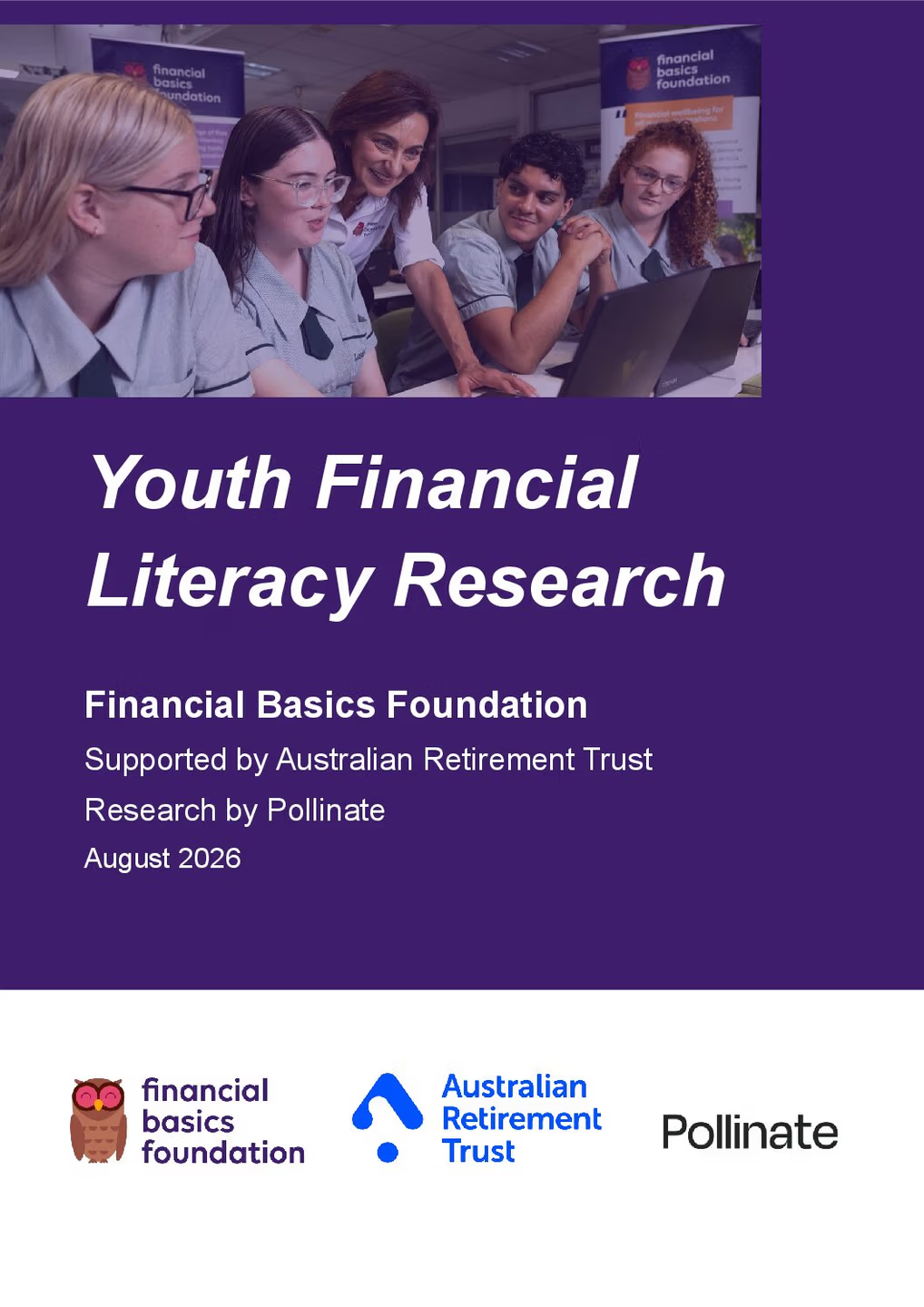
Youth Financial Literacy
Unpacking the financial confidence and capability of young Australians
Financial Basics Foundation (FBF) and Australian Retirement Trust (ART) commissioned this research to understand the financial wellbeing, confidence and capability of young Australians; and identify how best to support young people in building lifelong financial resilience. The research provides a national view of young Australians’ financial experiences and the factors influencing future wellbeing. The research is based on a nationally representative survey of 1,005 Australians aged 16–24, supported by qualitative interviews and an FBF participant sample.
Details
Title: Youth Financial Literacy Research
Commissioned by: Financial Basics Foundation, supported by Australian Retirement Trust
Research by: Pollinate
From: Financial Basics Foundation, 2026
Citation: Financial Basics Foundation, Australian Retirement Trust (2026) Youth Financial Literacy Research. Financial Basics Foundation.
[1] Research in this paper was commissioned by Financial Basics Foundation and Australian Retirement Trust June 2026. Pollinate ran a nationally representative survey of 1,005 Australians aged 16–24, supported by qualitative interviews and an FBF participant sample.
Financial Basics Foundation (FBF) is a national not-for-profit dedicated to helping young Australians build the financial skills, confidence and resilience they need for life. Through evidence-based, curriculum-aligned resources and programs, FBF supports students to navigate real-world financial decisions, from budgeting and saving to understanding risk. Educators from 2,521 schools representing approximately 73% of Australia’s secondary and special schools using FBF resources each year.
Australian Retirement Trust (ART) is one of Australia’s largest superannuation funds, trusted by more than 2.4 million Australians to manage around $375 billion in retirement savings. ART believes a fairer super system starts with strong financial wellbeing. The earlier people build financial knowledge, confidence and capability, the better equipped they are to make financial decisions throughout life. Through its partnership with Financial Basics Foundation, ART has helped more than 14,000 young people access the Cashed Up program since October 2024, helping build stronger financial foundations for the future.